
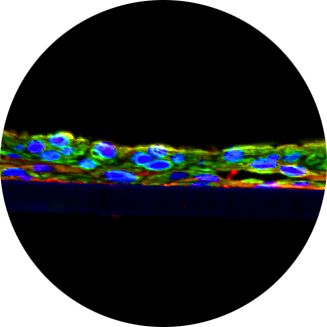
Tissue Models
Evaluation of an in-vitro test protocol using a three-dimensional human buccal oral mucosal model to assess the oral medical devices
- TR Number: 1106
- Authors: Ji-Yeon Hong, Hyo-Ju An, Min-Su Park, Do-Yeon Kim, Eun-Jung Lee, Marek Puskar, Christian Pellevoisin, Jae-Sung Kwon
- Keywords: EpiOral ORL-200, irritation, oral medical devices, leachables, dose volume, WST-1, MTT, ET-50, extraction vehicle, pre-incubation time, methyl acetate, Triton X-100, sodium lauryl sulfate (SLS), phosphoric acid, benzalkonium chloride, saline, sesame oil, hydrogen peroxide, glycerol, polyethylene glycol
- Materials Tested: methyl acetate, Triton X-100, sodium lauryl sulfate (SLS), phosphoric acid, benzalkonium chloride, saline, sesame oil, hydrogen peroxide, glycerol, polyethylene glycol
- Institution: Department and Research Institute of Dental Biomaterials and Bioengineering, Yonsei University College of Dentistry, Republic of Korea, BK21 FOUR Project, Yonsei University College of Dentistry, Seoul, Republic of Korea, Yonsei Global Dental Device Evaluation and Supporting Center, Yonsei University Dental Hospital, Seoul, Republic of Korea, Department of Information and Statistics, Chungnam National University, Daejeon, Republic of Korea, Mattek IVLSL, Now Part of Sartorius, Bratislava, Slovakia, Urbilateria, Tours, France
- Link to Article: https://www.sciencedirect.com/science/article/abs/pii/S0887233326000834
Abstract
This study establishes an in vitro protocol using the EpiOral three-dimensional human buccal oral mucosal model to assess potential irritation from oral medical devices and their leachables. EpiOral tissues were exposed to test substances (e.g., methyl acetate, Triton X-100, sodium lauryl sulfate (SLS), phosphoric acid, benzalkonium chloride) at concentrations relevant to dental materials, with exposure time for 50% tissue viability (ET-50) calculated from viability assays at 1, 4, and 18 h. The application volumes of the test substances (40 μL and 100 μL), vehicle controls (saline, sesame oil), and a 50% viability cut-off were validated using linear mixed models (LMM), post-hoc comparisons, and ROC analysis with Youden’s index. ET-50 assays correctly classified the test irritants: strong (e.g. SLS, phosphoric acid, ET-50 < 1 h), moderate (hydrogen peroxide, 1.12 h), and non-irritants (e.g., glycerol, polyethylene glycol >18 h). No significant viability differences occurred between 40 μL and 100 μL for most substances (p > 0.05), except hydrogen peroxide. Using a 50% viability cut-off for irritancy classification, all tested substances were correctly classified in this exploratory dataset (sensitivity/specificity = 1.000). The in vitro testing protocol using the EpiOral model provides a structured experimental approach for oral mucosal irritation assessment. Under the conditions evaluated in this study, a 100 μL application volume and a 50% viability threshold were found to be appropriate.