
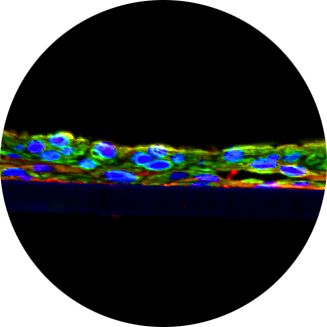
Visualization of oxygen profile in reconstructed human epidermis by phosphorescence-lifetime imaging microscopy using Ir(III) complex
- TR Number: 1104
- Authors: Misaki Ochiai-Noguchi, Aoi Horikoshi, Seina Hirakata, Toshitada Yoshihara
- Keywords: EpiDerm, EPI-201, EPI-100-NMM-3, histology, apoptosis TUNEL, confocal phosphorescence-lifetime imaging microscopy PLIM, cell-permeable phosphorescent probe, BTPDM1, iridium-based cationic lipophilic dye, Z-stack phosphorescence, partial pressure pO2, FCCP, carbonyl cyanide p-(trifluoro-methoxy)phenylhydrazone, uncoupler of mitochondrial oxidative phosphorylation, Antimycin A Ant A, filaggrin, loricrin, keratin 1, mitochondrial respiration, oxygen consumption, epidermal differentiation
- Materials Tested: Antimycin A, BTPDM1 iridium-based cationic lipophilic dye
- Institution: MIRAI Technology Institute, Shiseido Co., Ltd, 1-2-11, Takashima, Nishi-ku, Yokohama-shi, Kanagawa, 220-0011, Japan, Graduate School of Science and Technology, Gunma University, 1-5-1, Tenjin-cho, Kiryu-shi, Gunma, 376-8515, Japan, Graduate School of Science and Technology, Gunma University, 1-5-1, Tenjin-cho, Kiryu-shi, Gunma, 376-8515, Japan
- Link to Article: https://pubmed.ncbi.nlm.nih.gov/41093875/
Abstract
Reconstructed human epidermis (RHE) is a useful experimental tool for evaluating the effects of various stimuli on the skin. Here, we present a method to visualize the partial pressure of oxygen in RHE with cellular-level spatial resolution by means of confocal phosphorescence-lifetime imaging microscopy (PLIM) with a cell-permeable phosphorescent probe, BTPDM1 (an iridium-based cationic lipophilic dye). Z-stack PLIM images of RHE revealed an oxygen partial pressure gradient in the direction of differentiation, with a decrease in oxygen levels from the basal layer to the cornified layer. FCCP (carbonyl cyanide p-(trifluoromethoxy)phenylhydrazone), an uncoupler of mitochondrial oxidative phosphorylation, significantly decreased pO₂, suggesting that changes in mitochondrial respiration may contribute to the O₂ concentration gradient in RHE. Antimycin A (Ant A), an inhibitor of mitochondrial respiration, decreased expression of the differentiation markers filaggrin and loricrin, indicating that mitochondrial respiration is essential for normal epidermal maturation. In 2D keratinocyte cultures, addition of calcium as a differentiation inducer led to an increase in mitochondrial oxygen consumption and oxidative phosphorylation. These results indicate that oxygen imaging is an effective method for evaluating not only mitochondrial respiration status, but also the differentiation state of reconstructed human epidermis.