
INTERACTION BETWEEN THE HEMAGGLUTININ-NEURAMINIDASE AND FUSION GLYCOPROTEINS OF HUMAN PARAINFLUENZA VIRUS TYPE III REGULATES VIRAL GROWTH IN VIVO.
- TR Number: 753
- Authors: Xu1, R., Palmer2, S.G., Porotto2, M., Palermo2, L.M., Niewiesk3, S., Wilson1,4, I.A., Moscona2, A. 1Department of Integrative Structural and Computational Biology, The Scripps Research Institute, La Jolla, California, USA. 2Departrnent of Pediatrics and Department of Microbiology and Immunology, Weill Medical College of Cornell University, New York, New York, USA. 3Department of Veterinary Biosciences, College of Veterinary Medicine, the Ohio State University, Columbus, Ohio, USA. 4Skaggs Institute for Chemical Biology, The Scripps Research institute, La Jolla, California, USA.
- Keywords: AIR-100 vs. cell lines, bronchiolitis, croup, EpiAirway (AIR-100), fusion protein, glycoproteins, hemagglutinin-neuraminidase, human parainfluenza virus type 3 (HPIV3), pneumonia
- Materials Tested: Human parainfluenza virus type 3, influenza virus
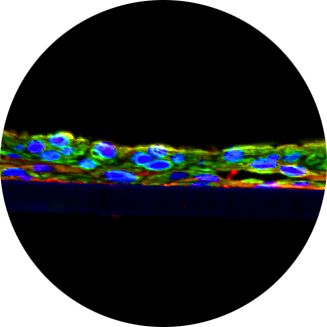
Paramyxoviruses, enveloped RNA viruses that include human parainfluenza virus type 3 (HPIV3), cause the majority of childhood viral pneumonia. HPIV3 infection starts when the viral receptor-binding protein engages sialic acid receptors in the lung and the viral envelope fuses with the target cell membrane. Fusion/entry requires interaction between two viral surface glycoproteins: tetrameric hemagglutmin-neuraminidase (HN) and fusion protein (F). In this report, we define structural correlates of the HN features that permit infection in vivo. We have shown that viruses with an HN-F that promotes growth in cultured immortalized cells are impaired in differentiated human airway epithelial cell cultures (HAE) and in vivo and evolve in HAE into viable viruses with less fusogenlc HN-F. In this report, we identify specific structural features of the HN dimer interface that modulate HN-F interaction and fusion triggering and directly impact infection. Crystal structures of HN, which promotes viral growth in vivo, show a diminished interface in the HN dimer compared to the reference strain’s HN, consistent with biochemical and biological data indicating decreased dimerization and decreased interaction with F protein. The crystallographic data suggest a structural explanation for the HN’s altered ability to activate F and reveal properties that are critical for infection in vivo.