
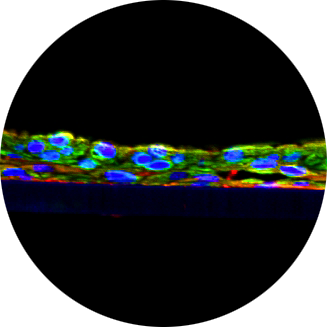
Differential Cytokine and DNA Damage Response of Human Lung Tissue Models to Broad-Beam and Microbeam Radiotherapy
- TR Number: 1117
- Authors: Aleksandra Čolić (1) (2), Marina Santiago Franco (1) (2), Narayani Subramanian (1) (2), Mabroor Ahmed (1) (2), Susanne Raulefs (1) (2), Jessica Müller (3), Stefan Bartzsch (1) (2), Stephanie E Combs (1) (2), Thomas E Schmid (1) (2), Harry Scherthan (3)
- Keywords: EpiAlveolar, ALV-100-FT-PE12, radiation-induced lung injury, lung cancer, broad-beam radiotherapy, microbeam radiotherapy, tumor necrosis factor alpha, TNF-a, monocyte chemoattractant protein 1 MCP1, IL6, IL8, TGF-b1, IHC, γH2AX, 53BP1, alpha smooth muscle actin, vimentin, collagen type 1 alpha 1 COL1A1, DNA double-strand break, fibrotic collagen deposition, fibrosis, pneumonitis, cell number
- Materials Tested: broad-beam radiation, microbeam radiation
- Institution: (1) Department of Radiation Oncology, TUM School of Medicine and Health, TUM University Hospital, Technical University of Munich, Ismaninger Straße 22, 81675 Munich, Germany, (2) Institute of Radiation Medicine (IRM), Helmholtz Zentrum München GmbH, German Research Center for Environmental Health, 85764 Neuherberg, Germany, (3) Bundeswehr Institute of Radiobiology affiliated to the University of Ulm, Neuherbergstr. 11, 80937 Munich, Germany
- Link to Article: https://pubmed.ncbi.nlm.nih.gov/41892291/
Abstract
Radiotherapy (RT) is a standard treatment for lung cancer; however, radiation-induced toxicities such as pneumonitis and fibrosis limit dose escalation and tumor control. Therefore, improved RT approaches are needed. This study investigated the radiation response of human ex vivo normal lung tissue using the three-dimensional EpiAlveolar™ model. Tissue models were irradiated with broad-beam (BB) and two spatially fractionated microbeam radiation therapy (MRT) dose metrics: equivalent uniform dose (MRT-EUD) and valley dose (MRT-valley). Our findings show that ex vivo lung tissue is able to tolerate peak doses of 36 Gy following MRT-EUD. On day 21, models effectively repaired significant DNA double-strand break (DSB) damage seen in the MRT-EUD-irradiated peak regions. In contrast, persistent unresolved DSBs were detected in MRT-valley-irradiated models 21 days post irradiation. Prolonged culture time resulted in cell loss and a reduction in epithelial cell layers. A significant upregulation of the pro-inflammatory cytokine IL6 was observed in both BB and MRT-EUD groups at 21 days. Fibrotic collagen deposition was detected in one BB-irradiated model but was absent in remaining BB- and MRT-treated tissues. Further investigation is required to clarify the potential and suitability of EpiAlveolar™ models for studying radiation-induced lung injury.