
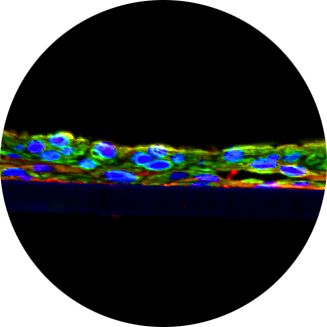
Modified Screening Methodology Evaluating the Ocular Irritation Potential Using Human Corneal Epithelium Model EpiOcular for Cosmetic and Personal-Care Products
- TR Number: 1097
- Authors: Courtney Nabua, Emily Acquaviva, Emma Lear, Megan Creelman, Jessica Swade, Carolee Schnittger, Nathan Wilt, Gertrude-Emilia Costin, Huang Huang
- Keywords: EpiOcular OCL-200, ocular irritation, cosmetic products, personal care products, ET-50, extended exposure times, eye area creams, face area creams, facial oils, primer, serums, sunscreens, foundations, cleansers, raw materials, time to toxicity, neat test materials
- Materials Tested: eye area creams, face area creams, facial oils, primer, serums, sunscreens, eye area products, face area products, foundations, cleansers, raw materials
- Institution: Institute for In Vitro Sciences, Inc. (IIVS), Gaithersburg, MD, USA, The Estée Lauder Companies, Inc., Melville, NY, US
Abstract: Evaluating ocular irritation is critical for the safety assessment of facial and eye area cosmetics. One of the most sensitive and human-relevant eye irritation test methods is an adaption of the time-to-toxicity protocol using a reconstructed human corneal epithelium model (EpiOcularTM, Mattek Corporation). Depending on the expected irritation potential (based on the product type, application, formula composition, etc.), this protocol can be applied with two standard exposure methodologies: standard exposure (up to 4 hours) or extended exposure (up to 24 hours) for products expected to be very mild. Both protocols use 4-5 exposure times to capture the exposure duration that results in a 50% reduction in tissue viability, as determined by MTT conversion assay, relative to control cultures (ET50 value). In cases where limited information is available for expected irritation potential, multiple definitive assays may be needed to capture the ET50 value. This study proposes a modified wide-range methodology using extended exposure times. All products were tested without dilution, by topical application to the EpiOcularTM tissue equivalents. Comparisons of the ET50 value and corresponding irritation level from both the standard and modified protocols were made, suggesting this modified methodology would be a useful tool, especially when products are developed with limited toxicity information.