
Tissue Models
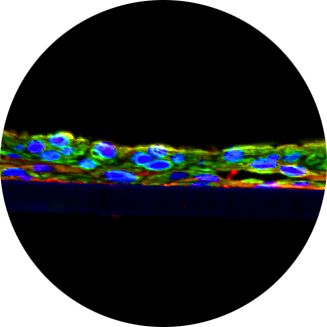
Elucidating the Impact of Bacterial Composition and Diversity on Skin Homeostasis Using a Human 3D In Vitro Skin Model
- TR Number: 1108
- Authors: Maya Sophie Kissner, Aline Rosin, Heike Sprenger, Giorgio Gonnella, Klaus Neuhaus, Amro Abbas, Hyun-Dong Chang, Tewes Tralau, Jannike Lea Krause, Tessa Höper, and Lisa Lemoine
- Keywords: EFT-400-ABF, skin microbiome, bacteria count, bacterial colonization, epidermal transcriptome, epidermal thickness, e-cadherin, cytokeratin 10, CK10, H&E staining, fibroblast growth factor (FGF) release, adenylate kinase, microbiota–skin interaction, Staphylococcus capitis, Staphylococcus condiment, Staphylococcus epidermidis, Staphylococcus warneri, Kocuria rhizophila, Micrococcus luteus strain 1, Micrococcus luteus strain 2, Brevibacterium frigoritolerans, Acinetobacter radioresistens, Pseudomonas fulva, Bacillota, Actinomycetota, Pseudomonadota
- Materials Tested: bacteria, Staphylococcus capitis, Staphylococcus condiment, Staphylococcus epidermidis, Staphylococcus warneri, Kocuria rhizophila, Micrococcus luteus strain 1, Micrococcus luteus strain 2, Brevibacterium frigoritolerans, Acinetobacter radioresistens, Pseudomonas fulva, Bacillota, Actinomycetota, Pseudomonadota
- Institution: Department of Pesticides Safety, German Federal Institute for Risk Assessment (BfR), 10589 Berlin, Germany, Institute of Biotechnology, Technical University of Berlin, 13355 Berlin, Germany, Department of Food Safety, German Federal Institute for Risk Assessment (BfR), 10589 Berlin, Germany, Bioinformatics and AI Applications Unit, Institut Pasteur du Cambodge, Pasteur Network, Phnom Penh 120210, Cambodia, Core Facility Microbiome, ZIEL—Institute for Food & Health, Technical University München, 85354 Freising, Germany, German Rheumatology Research Centre Berlin, A Leibniz Institute, 10117 Berlin, Germany, German Federal Institute for Risk Assessment (BfR),10589 Berlin, Germany
- Link to Article: https://www.mdpi.com/2076-2607/14/8/1722
Abstract
The importance of the skin microbiome in human health has become increasingly evident. Despite considerable advancements, complex host–microbe interactions remain largely unexplored, primarily due to a paucity of models mimicking human skin and maintaining bacterial diversity in vitro. Therefore, we assessed the role of bacterial diversity for skin–microbiota co-cultivation in vitro by co-culturing reconstructed human full-thickness skin models with one of seven defined bacterial communities for seven days. The most diverse ten-strain community (BAP.10) comprised the three main skin phyla Bacillota, Actinomycetota, and Pseudomonadota. Lower diversity was obtained by the inoculation with two and one phyla combinations only. Inoculations with higher bacterial diversity were maintained at physiological bacterial counts and resulted in a higher functional similarity to human skin microbiomes, with BAP.10 showing the closest resemblance. In contrast, colonization with a single phylum led to either absence of viable bacteria or overgrowth of a single species. Overgrowth was associated with impaired skin integrity and cytotoxicity. Our data demonstrate the importance of bacterial diversity and the presence of certain genera for human-relevant skin co-culture models, which can be used for future in vitro studies elucidating skin–microbiome interactions.