
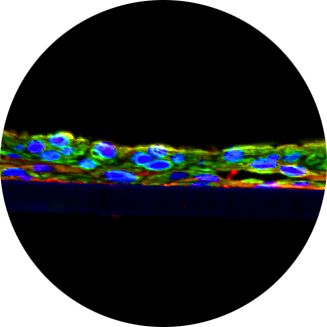
Advancing dermal genotoxicity assessment with RSMN and RS Comet in human 3D skin models
- TR Number: 1110
- Authors: E. Reis, M. Puskar, A. Armento, V. Karetsky, M. Klausner, J.Markus, S. Letasiova
- Keywords: EFT-400, comet assay, EFT-400-K2, multiple donors, direct genotoxins, non-genotoxins, non-direct genotoxins, chromosomal damage, clastogens, aneugens, primary DNA strand breaks, alkali-labile lesions, mitomycin C, methyl methanesulfonate (MMS), Vinblastine sulfate, β-Butyrolactone, Dimethylcarbamoyl chloride, n-Ethylnitrosourea, n-Methyl-N-nitrosourea, Tris(2,3-dibromopropyl) phosphate, Colchicine, Ethyl methanesulfonate, acetone, reconstructed skin micronucleus assay (RSMN), 4-Nitrophenol (p-nitrophenol), 1,2-Epoxydodecane, Trichloroethylene, Apigenin, Ethohexadiol, Ampicillin trihydrate, n-Butyl chloride, Cyclohexanone, Dimethylformamide, Dimethylterephthalate4-Nitroquinoline 1-oxide, Cyclophosphamide, Dimethyl benz[a]anthracene (DMBA), Dibenz[a,h]anthracene (DBA), Dimethylnitrosamine (DMN), Benzo[a]pyrene, Aniline, 2-Aminofluore
- Materials Tested: mitomycin C, methyl methanesulfonate (MMS), Vinblastine sulfate, β-Butyrolactone, Dimethylcarbamoyl chloride, n-Ethylnitrosourea, n-Methyl-N-nitrosourea, Tris(2,3-dibromopropyl) phosphate, Colchicine, Ethyl methanesulfonate, acetone, reconstructed skin micronucleus assay (RSMN), 4-Nitrophenol (p-nitrophenol), 1,2-Epoxydodecane, Trichloroethylene, Apigenin, Ethohexadiol, Ampicillin trihydrate, n-Butyl chloride, Cyclohexanone, Dimethylformamide, Dimethylterephthalate4-Nitroquinoline 1-oxide, Cyclophosphamide, Dimethyl benz[a]anthracene (DMBA), Dibenz[a,h]anthracene (DBA), Dimethylnitrosamine (DMN), Benzo[a]pyrene, Aniline, 2-Aminofluore
- Institution: Mattek, Bratislava, Slovakia, Mattek, Ashland, MA, USA
Standard in vitro genotoxicity assays are essential for hazard identification but may generate positive findings that are not confirmed in vivo. This represents a particular challenge for cosmetic ingredients and other dermally applied substances for which animal follow-up testing is prohibited, restricted, or scientifically undesirable.
Three-dimensional reconstructed human skin models provide human-derived tissue architecture, barrier properties, topically relevant exposure conditions, and skin-associated metabolic activity that are not adequately represented by conventional submerged monocultures.
The reconstructed skin micronucleus assay (RSMN) detects fixed chromosomal damage resulting from clastogenic or aneugenic events, whereas the reconstructed skin Comet assay (RS Comet) detects primary DNA strand breaks and alkali-labile lesions. These endpoints provide complementary information on chemically induced genotoxic damage.
In 2025, the EURL ECVAM Scientific Advisory Committee concluded that the evidence supporting the scientific validity of the RS Comet and RSMN assays was sufficient and adequate for their defined uses as higher-tier follow-up methods for dermal genotoxicity assessment.
The purpose of this work was to integrate accumulated RSMN results generated in EpiDerm with a complementary RS Comet proof-of-concept in EpiDermFT , illustrating how these endpoints can broaden biological coverage in dermal genotoxicity assessment.