Epi2SensA (OECD TG 442D)
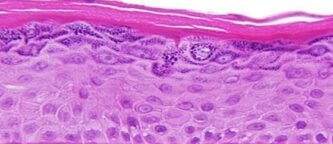
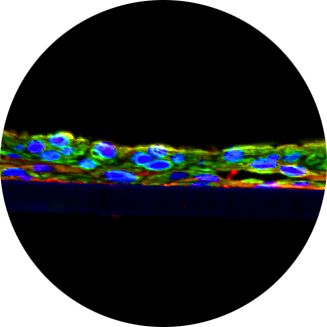
Epi2SensA is a non-animal, gene expression-based skin sensitization assay performed on the EpiDerm™ reconstructed human epidermis (RhE) model. The assay has been shown to be suitable for hydrophobic compounds and substances requiring metabolic activation (pre/pro‑haptens), which are often difficult to evaluate with simpler in vitro systems.
The Epi2SensA Assay is included in the updated version of the OECD TG 442D and Mattek offers the Epi2SensA Skin Allergenicity Testing as a service.
The updated version of the OECD TG 442D includes the Epi2SensA assay, run using the EpiDerm™ reconstructed human epidermis (RhE) model. Epi2SensA is a non-animal, gene expression-based skin sensitization assay performed using the EpiDerm™ reconstructed human epidermis (RhE) model. The assay has been shown to be suitable for testing hydrophobic compounds and substances requiring metabolic activation (pre/pro-haptens), which are often difficult to evaluate with simpler in vitro systems.
Epi2SensA assesses Key Event 2 (KE2), activation of keratinocytes, one of key steps that leads to allergic contact dermatitis1. Together with other non-animal tests that monitor KE1, covalent binding of electrophilic substances to skin proteins (“haptenization”), and KE3, activation of dendritic cells, Epi2Sensa can be used to label a material as an allergen or non-allergen. Importantly, Epi2Sensa and complementary assays avoid the need for laboratory animals in screening for contact allergenicity.
1: OECD (2014), The Adverse Outcome Pathway for Skin Sensitisation Initiated by Covalent Binding to Proteins, OECD Series on Testing and Assessment, No. 168, OECD Publishing, Paris, https://doi.org/10.1787/9789264221444-en.
Protocol
| Test Model | EpiDerm (Part# EPI-200-SENSA) |
| Replicates | N=3 tissues per test condition |
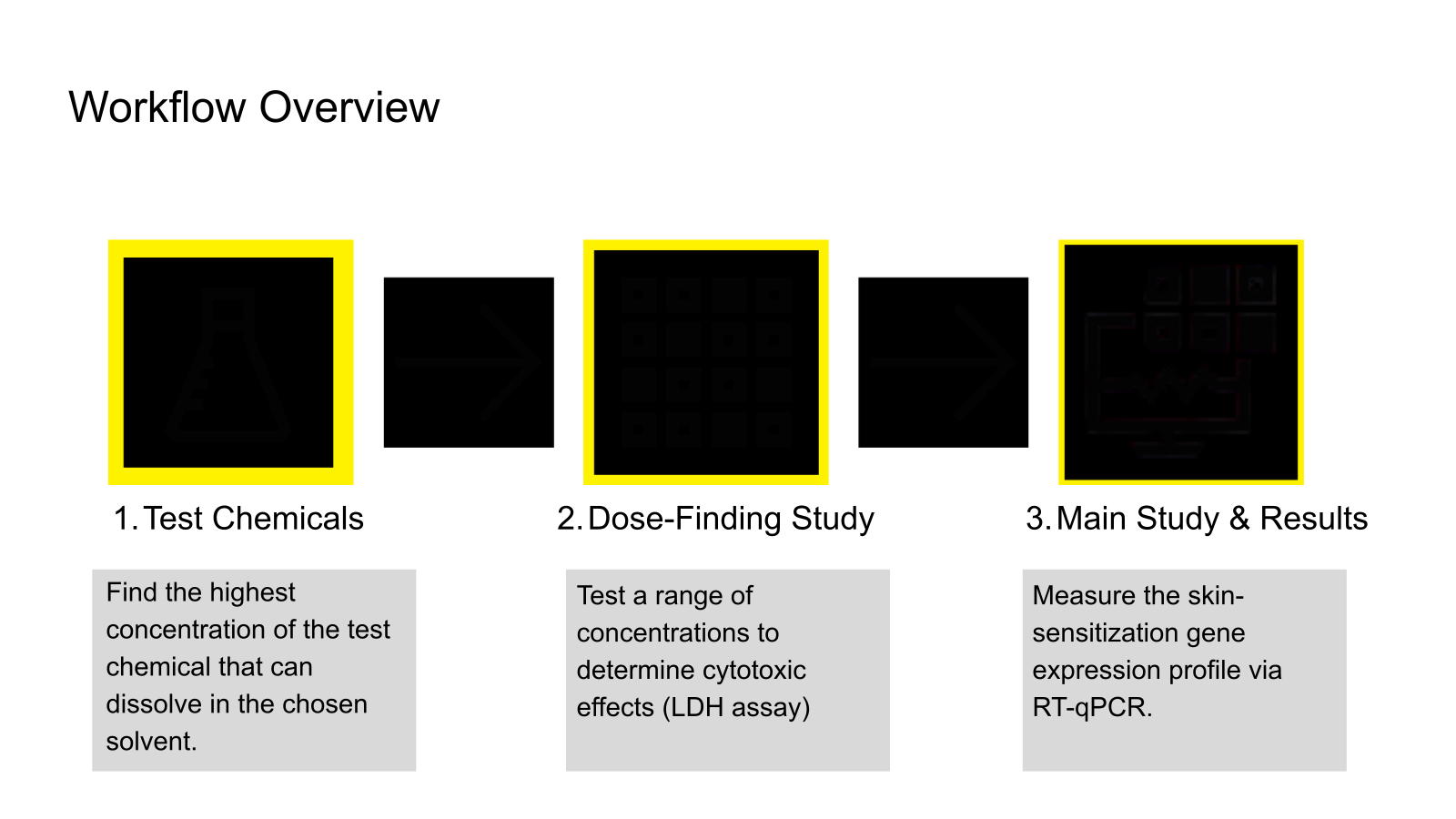
| Steps | Initial dose range finding to determine non-cytotoxic / cytotoxic concentrations Main study to assess gene induction |
| Exposure | Time: 1 hour topical exposure followed by 5 hr post-incubation Dose: 10µL of test material per tissue |
| Assay Controls | Vehicle Controls: 20% v/v Olive Oil in acetone (AOO), distilled water (DW) or 50% v/v ethanol in DW Positive controls: Clotrimazole 1,56%, 4-NBB 0,1% Killed control (10% Triton X-100 added to basal compartment) |
| Endpoints | LDH tissue viability assay Gene expression measured by RT-qPCR |
| Data Delivery | Cytotoxic / non-cytotoxic concentrations (% relative viability ± SD) Fold-induction of 4 genes |
| Integration (Defined Approach) | To be combined with DPRA or h-CLAT for final classification according to OECD TG497 In vitro classification as sensitizer or non-sensitizer |
Data
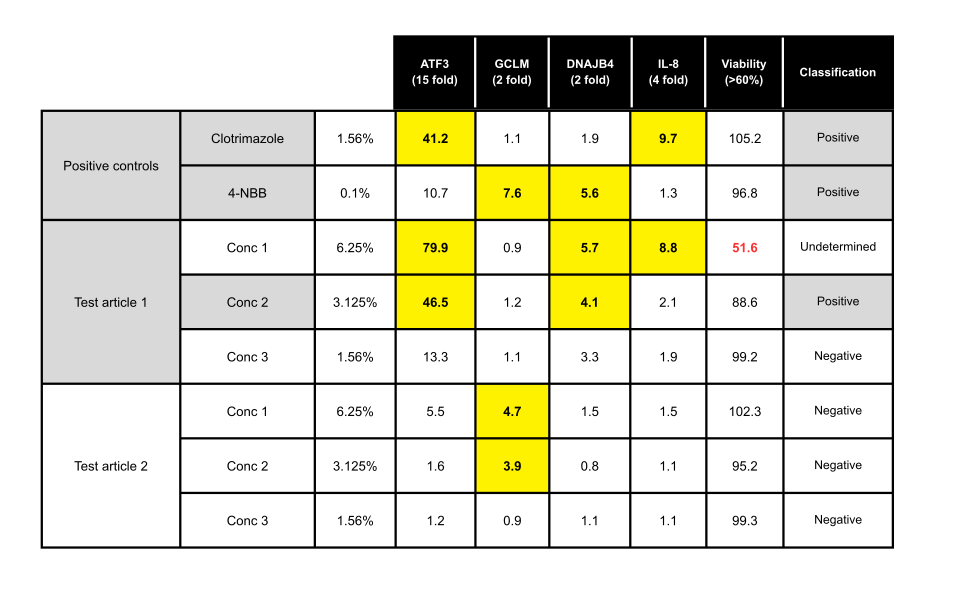
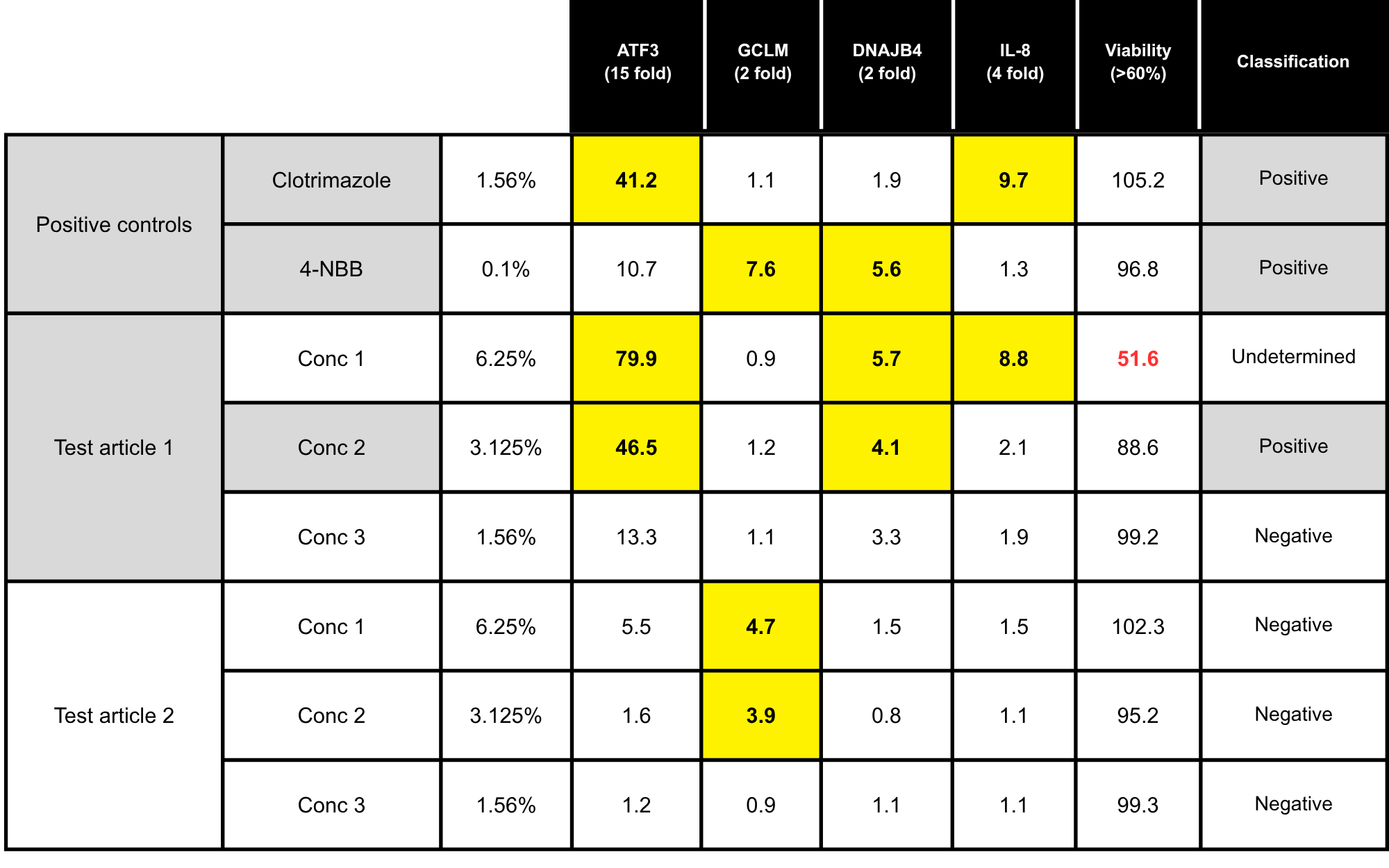
Test articles are considered positive if the expression of at least two marker genes exceed the respective cut-off value (ATF3, 15-fold; GCLM, 2-fold; DNAJB4, 2-fold; IL-8, 4-fold) with cell viability remaining ≥ 60%. For this purpose, the mean maximum fold-induction (Imax) value is determined using data from concentrations at which mean cell viability remains ≥ 60% for Epi2SensA.
Analysis is as follows:
▪ Clotrimazole is positive based on ATF3 and IL-8 induction.
▪ 4-NBB is positive based on the GCLM and DNAJB4.
▪ For Test article 1, Conc 2 is positive based on the induction of ATF3 and DNAJB4. Induction values for ATF3, DNAJB4, and IL-8 for Conc 1 are also above the cutoff values, but the test result must be excluded because the tissue viability is below 60%.
▪ For test article 2, induction of only one gene exceeds the cutoff values, so all concentrations are negative.
Request a Quote
Thank you for requesting information about Mattek products! A representative will contact you shortly.
**If you would like to place an order for Mattek products, please contact Customer Service**